
Artes Design: The Philosophy Behind Our Premium Furniture Collections
İçindekiler
- Material Selection: Wood Species and Structural Integrity
- Precision Manufacturing: CNC Tolerances and Joinery
- Upholstery Standards: Foam Densities and Fabric GSM
- Foam Specifications
- Fabric and Leather Standards
- Table and Surface Finishing
- Design Philosophy: Form Follows Engineering
- Quality Control and Warranty
- Key Takeaways
- Frequently Asked Questions
Artes Design: The Philosophy Behind Our Premium Furniture Collections
For over two decades, I have walked the factory floors of Turkey’s finest furniture manufacturers. I have seen the difference between a piece that lasts a generation and one that fails within a season. At Artes Design, that difference is not an accident—it is engineered. Our philosophy is rooted in three immutable pillars: material integrity, structural precision, and timeless design. This article pulls back the curtain on how we translate that philosophy into every piece we produce.
Our collections are not assembled; they are constructed. We reject particleboard, MDF core, and veneer wraps. Every solid-wood component is selected for density, grain stability, and visual character. Every joinery detail is calculated to withstand the natural movement of wood and the weight of daily use. This is not marketing—this is manufacturing protocol.
Material Selection: Wood Species and Structural Integrity
The foundation of any premium furniture piece is its raw material. At Artes Design, we source from managed forests in North America and Europe. Our primary species include:
- American Black Walnut (Juglans nigra): Janka hardness rating of 1,010 lbf. Chosen for its rich chocolate-brown heartwood, exceptional dimensional stability, and resistance to decay. We use only kiln-dried lumber to 6–8% moisture content, ensuring minimal movement post-production.
- European Oak (Quercus robur): Janka hardness ~1,350 lbf. Quarter-sawn to reveal medullary ray flecking. This cut reduces cupping and twisting, making it ideal for tabletops and chair frames. Our oak is air-dried for 12 months, then kiln-dried to 7–9% MC.
- Ash (Fraxinus excelsior): Janka hardness ~1,320 lbf. Our preferred species for bentwood components due to its superior steam-bending properties and shock resistance. Used in the Lina and Rio chair frames.
We reject rubberwood, poplar, and any species with a Janka rating below 900 lbf for structural components. Every board is inspected for knots, checks, and grain deviation before it enters the CNC envelope.
Precision Manufacturing: CNC Tolerances and Joinery
Our factory operates five 5-axis CNC routers with a positioning accuracy of ±0.1mm. This is not overkill—it is necessity. When a mortise-and-tenon joint is cut with a tolerance of 0.1mm, the glue line virtually disappears, and the joint achieves maximum shear strength. We use the following joinery standards across our collections:
- Through-Tenon with Wedge: Used on dining table bases and chair stretchers. The tenon extends through the mortise and is secured with a hardwood wedge, creating a mechanical lock that does not rely solely on adhesive.
- Double-Doweled Miter Joint: For case goods and drawer boxes. Dowels are 8mm diameter, fluted for glue distribution, and offset to prevent splitting.
- Bridle Joint: Applied to chair back-to-rail connections. This joint provides maximum glue surface area and resists racking forces.
All joints are assembled using Type-I PVAc adhesive (waterproof per EN 204/D4 standard). No staples, no pocket screws, no cam locks. If it cannot be repaired with a clamp and glue, it does not leave our shop.
Upholstery Standards: Foam Densities and Fabric GSM
Comfort is subjective, but support is measurable. Our upholstery specifications are based on contract-grade standards, designed to maintain integrity over years of use.
Foam Specifications
- Seat Core: High-resilience polyurethane foam, 50 kg/m³ density (HR50). Indentation load deflection (ILD) of 36–40. This provides a firm yet forgiving support that resists sagging. We do not use recycled foam or bonded foam.
- Back and Arm Padding: 35 kg/m³ density foam with ILD of 24–28. Wrapped in 200 g/m² polyester fiber for a soft hand feel without compromising shape retention.
- Webbing: Woven elastic webbing with a 50mm width, spaced at 60mm centers. Tension is set to 45 N using a calibrated tension tool. This system distributes load evenly and prevents foam bottoming out.
Fabric and Leather Standards
- Performance Fabrics: Minimum 300 GSM (grams per square meter) for woven fabrics. Martindale rub count of 40,000+ for residential use, 60,000+ for contract. We test for colorfastness to light (ISO 105-B02, rating 5).
- Leather: Full-grain, aniline-dyed bovine leather from Italian tanneries. Minimum thickness of 1.2mm. We reject corrected-grain, bonded, and bicast leathers. Each hide is hand-graded for scars and grain consistency.
Our sewing department uses bonded nylon thread (size 92) with a tensile strength of 4 kg. Stitch density is 4 stitches per cm (10 per inch) for straight seams, 3 per cm for curves. No seam is left unfinished—all are bound or serged to prevent fraying.
Table and Surface Finishing
Our solid-wood tabletops are finished with a two-part polyurethane lacquer (PU) applied in three coats. The first coat is a sealer sanded to 320 grit, followed by two topcoats. Final sanding is done with 400 grit for a satin sheen. This finish provides resistance to heat (up to 80°C), alcohol, and household chemicals (NEMA LD-3 standards).
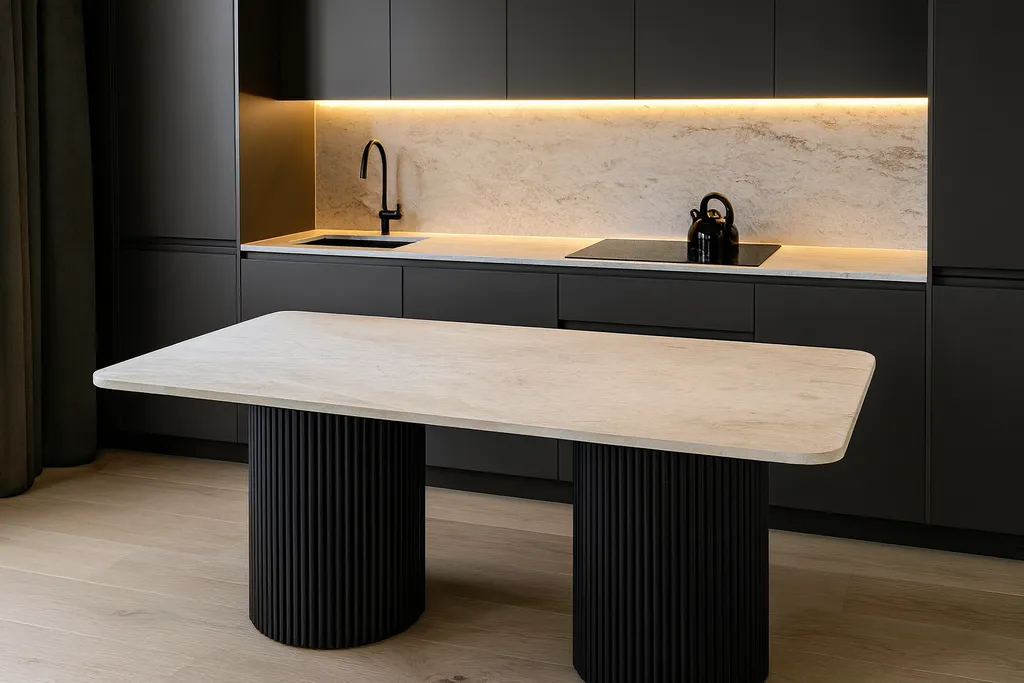
For our Traverten Masa, the stone is sourced from Turkish quarries (Denizli region). Each slab is cut to 30mm thickness, reinforced with fiberglass mesh on the underside, and sealed with a penetrating stone sealer. The steel base is powder-coated with a textured finish (60–80 micron thickness) after phosphate degreasing and pretreatment.
Design Philosophy: Form Follows Engineering
We do not chase trends. Our design language is defined by proportion, balance, and structural logic. Every curve in a chair back is dictated by the lumbar spine’s natural lordosis. Every table leg angle is calculated to resist lateral racking. Our in-house design team works alongside structural engineers—not marketing departments.
We maintain a library of 300+ jigs and templates, each refined over years of production. When we introduce a new model, it undergoes a 500-cycle load test on the seat and a 10,000-cycle swivel test (for rotating chairs). Only pieces that pass without structural failure enter our collection.
Quality Control and Warranty
Every piece is inspected at three points: raw material intake, post-machining, and final assembly. Our QC checklist includes:
- Moisture content verification (pin-type meter, 3 readings per component)
- Joint gap measurement (max 0.2mm visible gap)
- Finish adhesion test (cross-hatch tape test per ASTM D3359)
- Upholstery seam strength (pull test at 10 kg force)
We offer a 5-year structural warranty on all solid-wood frames and a 2-year warranty on upholstery and finishes. This is not a marketing gimmick—it is a contractual commitment to our manufacturing standards.
Key Takeaways
- Material Integrity: We use only solid American Black Walnut, European Oak, or Ash. Janka hardness above 1,000 lbf. No MDF, particleboard, or veneer.
- Precision Joinery: Mortise-and-tenon, through-tenon with wedge, double-doweled miter. CNC tolerances of ±0.1mm. Type-I waterproof adhesive.
- Upholstery Standards: HR50 foam (36–40 ILD), minimum 300 GSM fabric, 40,000+ Martindale rub count. Full-grain leather only.
- Finish: Three-coat PU lacquer, sanded to 400 grit. Heat and chemical resistant. Natural stone sealed and reinforced.
- Engineering-Led Design: Every piece is load-tested. Design decisions are validated by structural analysis, not aesthetics alone.
- Warranty: 5-year structural, 2-year finish/upholstery. Backed by documented QC processes.
Frequently Asked Questions
What is the difference between Artes Design furniture and mass-produced alternatives?
The difference lies in material selection, joinery, and quality control. Mass-produced furniture often uses engineered wood (MDF/particleboard) with cam-lock fasteners and staples. Artes Design uses solid hardwood with through-tenon and mortise joints, assembled with waterproof adhesive. Our CNC tolerances are ±0.1mm versus industry standard ±0.5mm. We also test every piece for load capacity and finish adhesion before shipment.
How should I care for my Artes Design solid-wood furniture?
Dust regularly with a soft, dry cloth. Avoid direct sunlight and extreme humidity fluctuations (ideal range: 40–60% RH). Clean spills immediately with a damp cloth—do not allow liquids to sit on the surface. For PU-lacquered surfaces, use a mild soap solution (pH neutral). Do not use silicone-based polishes, as they can degrade the lacquer over time. For travertine surfaces, use a stone-specific cleaner and reapply sealer every 12–18 months. Periodically check and tighten any visible hardware (though our joinery minimizes the need).
Can I order custom dimensions or fabrics for Artes Design pieces?
Yes, we offer a custom order program for select collections. Minimum order quantities apply for custom fabric runs (typically 10+ units). Custom dimensions are subject to engineering review—we will not modify a design in a way that compromises its structural integrity. Lead times for custom orders are 6–8 weeks. Please contact our sales team via the contact page or visit our wholesale portal for trade inquiries.
To explore our full range of premium furniture, visit our product collections or learn more about our manufacturing heritage.