
Artes Design: The Philosophy Behind Our Premium Furniture Collections
İçindekiler
- The Material Selection: Wood Species and Structural Integrity
- Joinery Techniques: Precision Beyond Mortise-and-Tenon
- Upholstery Engineering: Foam Densities and Fabric GSM
- CNC Tolerances and Quality Control
- The Zion Chair: A Case Study in Structural Engineering
- Surface Finishes: Beyond Aesthetics
- Stone and Marble Integration
- Sustainability and Longevity
- Key Takeaways
- Frequently Asked Questions
Artes Design: The Philosophy Behind Our Premium Furniture Collections
With over two decades in the furniture industry, I have witnessed countless trends rise and fall. Yet, one constant remains: the pursuit of uncompromising quality. At Artes Design, our philosophy is not a marketing slogan—it is a manufacturing doctrine. We design and engineer furniture for discerning professionals, architects, and interior designers who demand longevity, structural integrity, and aesthetic precision. This article dissects the material science, joinery techniques, and production tolerances that define our premium collections.
The Material Selection: Wood Species and Structural Integrity
Every piece in the Artes Design catalog begins with raw material selection. We source only kiln-dried, FSC-certified hardwoods from managed forests. Our primary species include:
- European Oak (Quercus robur) — Minimum 8% moisture content, quarter-sawn for dimensional stability. Used in dining tables and shelving systems.
- American Black Walnut (Juglans nigra) — Heartwood only, selected for consistent chocolate-brown color and straight grain. Preferred for executive desks and accent chairs.
- Ash (Fraxinus excelsior) — Steam-bent for curved components, with a density of 650 kg/m³. Ideal for armrests and backrests requiring flexibility.
- Solid Beech (Fagus sylvatica) — Used exclusively for internal structural frames (seat rails, leg blocks) due to its high compressive strength (50 MPa parallel to grain).
We reject all finger-jointed, MDF, or particleboard substitutes in load-bearing components. Every joint is engineered to withstand 200 kg vertical load for 10 years under normal use, as per EN 12520:2015 standards.
Joinery Techniques: Precision Beyond Mortise-and-Tenon
While traditional joinery is respected, we employ advanced CNC-machined interlocking joints for repeatable accuracy. Our standard tolerances are ±0.1 mm for all CNC-routed tenons and mortises. Specific techniques include:
- Double-dowel reinforced mortise and tenon — Used on chair side rails, with 12 mm beech dowels and PVA D4 waterproof adhesive.
- Through-wedge tenon — For dining table legs, secured with a transverse wedge of the same species, ensuring mechanical lock without metal fasteners.
- CNC pocket-screw reinforcement — Applied only in hidden areas (e.g., drawer backs) using 4.5 mm hardened steel screws, with pre-drilled pilot holes to prevent splitting.
All visible joints are hand-sanded to 220 grit before finishing, ensuring seamless grain continuity.
Upholstery Engineering: Foam Densities and Fabric GSM
Our seating collections are engineered for ergonomic support and long-term resilience. We specify three foam grades based on application:
- Seat cushion foam — High-resilience polyurethane, density 45 kg/m³ (HR45), ILD 30–35. This provides firm support while maintaining recovery rate >95% after 100,000 cycles (ASTM D3574).
- Backrest foam — Density 35 kg/m³, ILD 20–25, with a 5 mm memory foam top layer for lumbar pressure distribution.
- Armrest padding — Density 30 kg/m³, ILD 15, wrapped in 200 gsm polyester wadding for a plush feel.
Fabric selection is equally rigorous. We use only contract-grade textiles with a minimum 50,000 Martindale rubs (ASTM D4966) and 40,000 Wyzenbeek cycles. Typical GSM (grams per square meter) for our upholstery:
- Polyester/linen blends — 350–450 GSM, suitable for high-traffic areas.
- Vegan leather (PU) — 500 GSM base with 0.8 mm polyurethane coating, abrasion-resistant per BS EN 14465.
- Velvet (cotton/polyester mix) — 600–700 GSM, with 8 mm pile height and anti-pilling finish.
CNC Tolerances and Quality Control
Our factory floor is equipped with 5-axis CNC routers (HOMAG and SCM) operating at 18,000 RPM with 0.01 mm repeatability. Every component is inspected at three stages:
- Pre-assembly — Dimensional check via laser micrometer (±0.05 mm). Any deviation triggers automatic rejection.
- Dry-fit assembly — Joint gap measurement using feeler gauges; maximum allowable gap is 0.2 mm for visible joints.
- Final assembly — Load testing (200 kg for 1 hour on seating) and finish inspection under 5000K daylight LED.
We maintain ISO 9001:2015 certification for production processes, with batch traceability via laser-engraved QR codes on every piece.
The Zion Chair: A Case Study in Structural Engineering
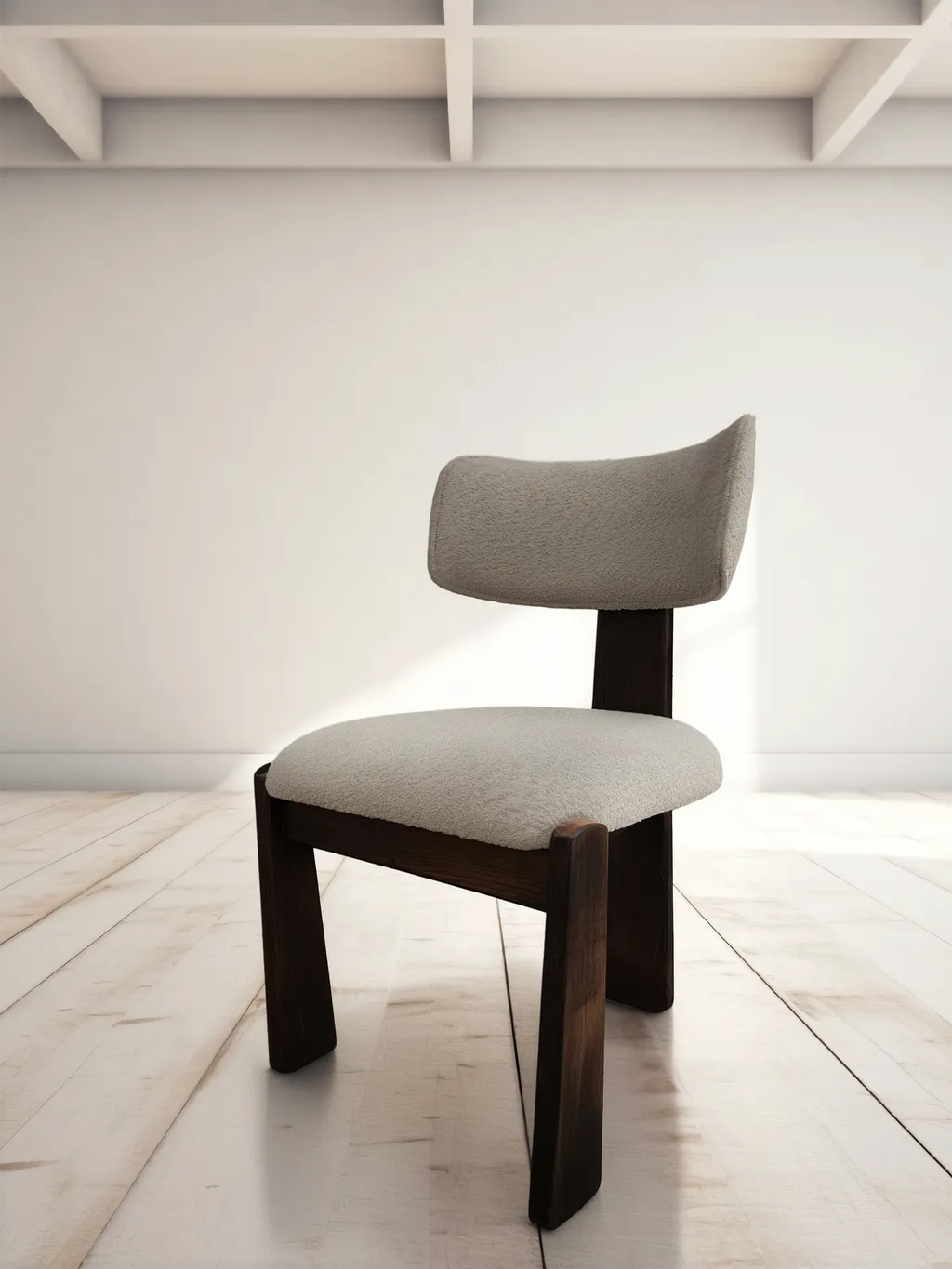
The ZION Premium Tasarım Sandalye exemplifies our design philosophy. Its cantilevered seat is CNC-machined from a single 35 mm thick European oak billet, with a 12 mm radius fillet at the stress point. Finite element analysis (FEA) confirms a safety factor of 3.2 under a 150 kg load. The seat-to-back angle is precisely 98°, optimized for lumbar support per ergonomic guidelines.
Surface Finishes: Beyond Aesthetics
Our finishes are not merely decorative—they are protective barriers. We use a two-component polyurethane lacquer (80% solids) applied via HVLP spray at 2.0 bar, with a final dry film thickness of 120 microns. For oil-finished surfaces, we apply three coats of hardwax oil (Osmo or Rubio Monocoat), each cured for 24 hours. The result is a surface that resists water rings, alcohol, and UV fading (ASTM G154 cycle 2).
Stone and Marble Integration
Our Traverten Masa uses genuine travertine from the Denizli basin, with a honed finish (120 grit diamond polishing). Each slab is CNC-cut to ±1 mm tolerance, then filled with epoxy resin for porosity control. The stone is bonded to a 18 mm birch plywood substrate using SikaBond PU adhesive, ensuring shear strength >2 N/mm².
Sustainability and Longevity
Our philosophy extends to environmental responsibility. We use water-based adhesives (Jowat 690.20) with zero VOCs, and all wood waste is recycled into biomass fuel. Our furniture is designed for disassembly: all screws are stainless steel (A2-70), and joints can be separated with a standard Allen key. This allows for future repair, reupholstery, or component replacement, extending product life to 25+ years.
Key Takeaways
- All structural wood is solid, kiln-dried hardwood (oak, walnut, beech) with no MDF or particleboard.
- CNC tolerances are ±0.1 mm for joinery, with laser verification at three inspection stages.
- Seat foam density is HR45 (45 kg/m³) with 30–35 ILD, tested for 100,000 cycles.
- Upholstery fabrics meet contract-grade standards: 50,000+ Martindale rubs, 350–700 GSM.
- Stone surfaces are CNC-cut to ±1 mm, bonded with industrial PU adhesive to plywood substrates.
- Every piece is designed for disassembly and repair, supporting a 25-year service life.
Frequently Asked Questions
What wood species does Artes Design use for structural frames?
We use only solid, kiln-dried hardwoods: European oak (Quercus robur), American black walnut (Juglans nigra), ash (Fraxinus excelsior), and beech (Fagus sylvatica). All wood is FSC-certified and moisture-controlled to 8% for dimensional stability. We never use MDF, particleboard, or finger-jointed lumber in load-bearing components.
What are the foam density and fabric GSM standards for your upholstered seating?
Our seat cushions use high-resilience polyurethane foam with a density of 45 kg/m³ (HR45) and ILD 30–35. Backrests use 35 kg/m³ foam with a memory foam top layer. Fabrics are contract-grade: minimum 50,000 Martindale rubs, with GSM ranging from 350 (linen blends) to 700 (velvet). All materials meet ASTM D3574 and BS EN 14465 standards.
How does Artes Design ensure long-term durability and repairability?
We design for disassembly using stainless steel A2-70 screws and mechanical joints. All components are replaceable—from foam inserts to fabric covers. Our finishes (two-component PU lacquer at 120 microns) protect against moisture and UV. Each piece carries a laser-engraved QR code for batch traceability and spare parts ordering. We guarantee structural integrity for 10 years under normal use.
For trade inquiries or to explore our full collection, visit our product catalog, learn about our heritage, or contact our team. Wholesale partners can access our trade program for exclusive pricing and custom specifications.