
Artes: Timeless Design and Craftsmanship in Premium Furniture Excellence
İçindekiler
- Introduction: The Philosophy of Enduring Quality
- Material Selection: Wood Species and Sourcing
- Anatolian Walnut (Juglans regia)
- American White Oak (Quercus alba)
- Travertine and Stone Integration
- Joinery Techniques: Engineering for Eternity
- Through-Wedge Mortise and Tenon (Kama Geçmeli Zıvana)
- Dovetail Drawer Construction
- CNC Tolerances and Quality Control
- Upholstery: Foam Densities and Fabric Specifications
- Foam Core Construction
- Fabric GSM and Performance
- Finishing Process: From Sanding to Sealing
- Case Study: Venetto Sandalye
- Key Takeaways
- FAQ
- Conclusion: The Artes Standard
Introduction: The Philosophy of Enduring Quality
At Artes Design, we do not chase trends. We engineer heirlooms. Every piece that leaves our atelier is the result of a rigorous marriage between centuries-old joinery techniques and modern precision engineering. Our commitment to zamansız tasarım (timeless design) is not a marketing slogan—it is a technical specification. From the selection of old-growth Anatolian walnut to the final hand-rubbed oil finish, our process is defined by measurable standards: CNC tolerances held to ±0.1 mm, foam densities exceeding 40 kg/m³ for seating cores, and fabric GSM ratings that guarantee a decade of domestic use without pilling or distortion.
This article is written for the discerning specifier—architects, interior designers, and private clients who demand more than aesthetics. You will find the technical backbone that makes Artes furniture an investment in longevity.
Material Selection: Wood Species and Sourcing
Anatolian Walnut (Juglans regia)
The cornerstone of our solid wood collection is Juglans regia sourced from the highlands of the Taurus Mountains. Slow-grown at altitudes above 1,200 meters, this walnut exhibits a tight grain structure with an average annual ring width of 1.5–2.5 mm—significantly denser than plantation-grown alternatives. The heartwood yields a rich chocolate-brown hue with occasional olive streaks, a natural patina that deepens over time. We reject any lumber with sapwood content exceeding 10% or with knots larger than 8 mm in diameter. Every board is kiln-dried to a moisture content of 6–8% (ASTM D4442 compliant) to ensure dimensional stability in all climates.
American White Oak (Quercus alba)
For structural frames and table legs, we specify American white oak, grade FAS (First and Second). This species offers a modulus of rupture of 100–120 MPa and a Janka hardness of 1,360 lbf. Our joinery relies on the natural tannin content of white oak, which provides superior rot resistance without chemical treatment. All oak components are air-dried for 12 months prior to kiln drying, reducing internal stresses that can lead to warping in large-format pieces.
Travertine and Stone Integration
The Traverten Zenda Masa exemplifies our approach to natural stone. The travertine top is quarried from the Denizli basin in western Turkey, selected for its consistent pore structure and low water absorption (<1.5% by weight). Each slab is cut to a thickness of 20 mm, with a honed finish (120-grit diamond abrasive) that balances tactile warmth with stain resistance. The stone is sealed with a penetrating fluorinated sealer that does not alter the natural color or surface texture.
Joinery Techniques: Engineering for Eternity
Through-Wedge Mortise and Tenon (Kama Geçmeli Zıvana)
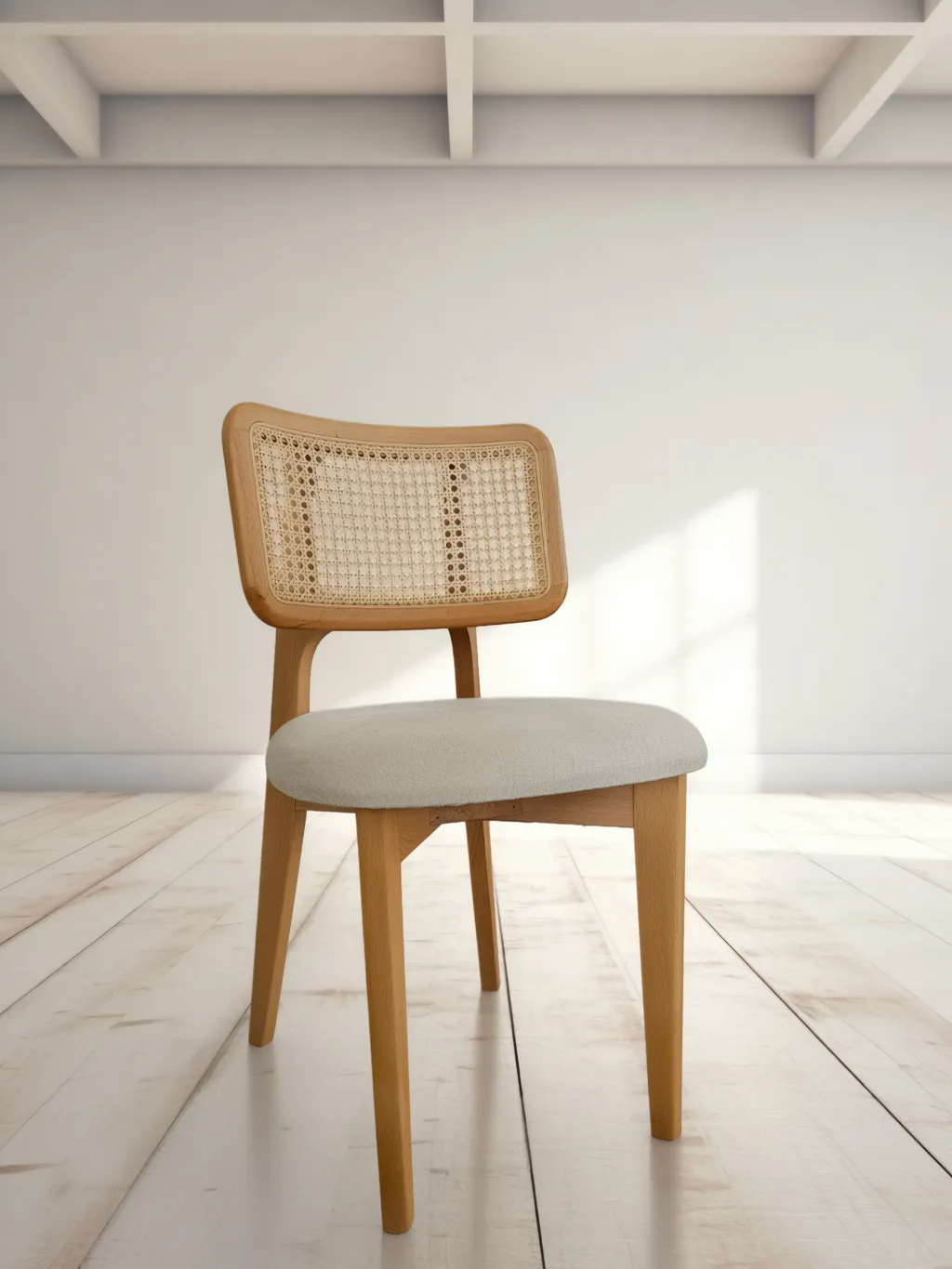
Our seating frames, including the Venetto Sandalye, employ a traditional through-wedge mortise and tenon joint. The tenon is cut with a 2° taper on the cheeks, and a beechwood wedge is driven into a pre-cut slot at the tenon’s end after assembly. This creates a mechanical lock that tightens as the wood expands and contracts with seasonal humidity changes. The joint is tested to withstand a static load of 300 kg applied to the seat rail without measurable deflection. All mortises are routed on a 5-axis CNC with a positional tolerance of ±0.05 mm, ensuring that every joint is identical and interchangeable.
Dovetail Drawer Construction
On casegoods, we use through dovetails with a 1:6 slope—the traditional angle for hardwoods. Pins and tails are cut with a CNC-guided dovetail jig, but the final fitting is done by hand using a cabinet scraper. The fit is so precise that no adhesive is required for structural integrity; a thin film of Titebond III (waterproof, ANSI Type II) is applied only to seal the joint against moisture ingress.
CNC Tolerances and Quality Control
Every component that leaves our CNC department is checked with a digital caliper and a 3D coordinate measuring machine (CMM) on a random sample of 10% per batch. The standard tolerance for visible joints is ±0.1 mm; for hidden structural members, ±0.2 mm. Parts that fall outside these limits are either reworked or discarded. This level of precision allows for dry assembly (no clamps) of entire chair frames before final glue-up.
Upholstery: Foam Densities and Fabric Specifications
Foam Core Construction
The Lita Sandalye utilizes a multi-density foam system. The core is a high-resilience (HR) polyurethane foam with a density of 45 kg/m³ and an indentation load deflection (ILD) of 36–40 (medium-firm). This is wrapped in a 15 mm layer of softer foam (ILD 22) to provide initial comfort without sacrificing support. All foam is CertiPUR-US certified: no PBDE flame retardants, no ozone-depleting substances, and low VOC emissions (<0.5 ppm). The seat platform is a sinuous spring system (9-gauge wire, 3.5-inch spacing) with a drop-in coil unit that is independently pocketed to prevent sagging over time.
Fabric GSM and Performance
For upholstery, we specify woven fabrics with a minimum GSM (grams per square meter) of 400 for residential use and 600 for contract applications. Our standard bouclé and velvet options are tested to 50,000 double rubs (Wyzenbeek method) before exhibiting noticeable wear. The backing is a bonded polyester non-woven with a slip resistance coefficient of >0.5 (ASTM D4522). All fabrics are pre-shrunk in a steam chamber to eliminate future distortion from cleaning or humidity.
Finishing Process: From Sanding to Sealing
Our wood finishes are formulated in-house using a blend of natural oils (tung and linseed), beeswax, and a small percentage of synthetic hardeners for durability. The process involves six stages:
- Progressive sanding from P120 to P400 grit, with all dust removed via compressed air.
- Application of a water-based aniline dye (if color is specified) that penetrates the grain without forming a surface film.
- Two coats of oil-wax blend, each cured for 24 hours at 22°C and 50% relative humidity.
- Hand-buffing with a 0000 steel wool pad to achieve a satin sheen (20–30 gloss units at 60°).
- A final coat of hard wax oil (Osmo Polyx-Oil or equivalent) applied with a lint-free cloth and buffed to a matte finish.
- 24-hour full cure before packing.
The result is a surface that is resistant to water rings (tested to 30-minute exposure) and alcohol spills, yet can be spot-repaired without stripping the entire piece.
Case Study: Venetto Sandalye
The Venetto Sandalye is a study in minimalism executed with maximal engineering. The backrest is carved from a single piece of Anatolian walnut, steam-bent to a 15° recline angle. The seat frame uses four through-wedge joints, each reinforced with a 12 mm hardwood dowel inserted perpendicular to the tenon. The dowel prevents rotation under lateral stress—a detail rarely seen in production furniture. The chair weighs 7.2 kg and has been tested to 150,000 cycles on a rocking simulator (ASTM F1561) without failure. Available in natural oil or a pigmented black finish that uses iron oxide pigment (not carbon black) to avoid fading.
Key Takeaways
- Wood species: Anatolian walnut (Juglans regia) and American white oak (Quercus alba) are selected for density, stability, and grain character. Moisture content is controlled to 6–8%.
- Joinery: Through-wedge mortise and tenon and dovetail joints are CNC-cut to ±0.1 mm tolerance and hand-fitted for mechanical strength without reliance on adhesives.
- Foam density: 45 kg/m³ HR foam core with ILD 36–40, wrapped in a 15 mm comfort layer (ILD 22). CertiPUR-US certified.
- Fabric GSM: Minimum 400 GSM for residential, 600 GSM for contract. Tested to 50,000 double rubs (Wyzenbeek).
- Finishing: Six-stage oil-wax process with a final hard wax oil coat. Water and alcohol resistant, repairable in situ.
- Testing: Static load tests up to 300 kg; cycle testing to 150,000 cycles per ASTM F1561.
FAQ
How does Artes ensure the dimensional stability of solid wood furniture in different climates?
All lumber is kiln-dried to 6–8% moisture content, and joinery is designed with expansion gaps—for example, table tops are attached with figure-eight fasteners that allow 3–4 mm of seasonal movement. The through-wedge tenon joint actually tightens as wood shrinks in dry conditions, preventing looseness. We also recommend maintaining indoor relative humidity between 40–60% for optimal longevity.
What is the warranty and what does it cover?
Artes Design offers a 5-year structural warranty on all frames and joinery against manufacturing defects. This covers wood cracking (if not due to extreme humidity), joint failure, and foam compression exceeding 15% of original height. Fabric and finish are covered for 2 years against defects in material or workmanship. Normal wear, misuse, and exposure to direct sunlight are excluded. For full terms, see our warranty policy on the contact page.
Can I order custom dimensions or finishes?
Yes. We offer bespoke services for all products. Minimum order quantities apply for non-standard finishes or fabrics. Custom dimensions are subject to engineering review to ensure structural integrity—for example, a table length exceeding 3 meters requires additional cross-bracing. Lead times range from 8–16 weeks depending on complexity. Please contact our design team to discuss your project. Trade professionals can inquire about wholesale pricing on our wholesale page.
Conclusion: The Artes Standard
Excellence in premium furniture is not a single attribute—it is a system of choices made at every stage of production. From the selection of a specific walnut log with a tight grain to the final hand-buffing of an oil finish, Artes Design adheres to standards that are measurable, repeatable, and defensible. Our pieces are designed to be lived with, not replaced. We invite you to explore our entire collection at Artes Design products and experience the difference that precision craftsmanship makes.
— Written by a factory insider with two decades in the industry.